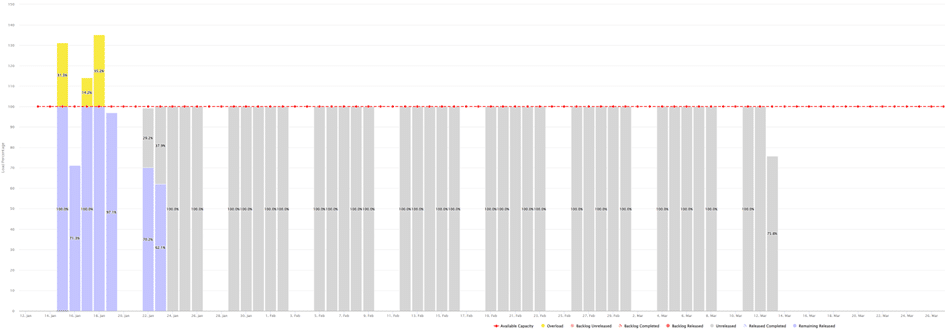
The graph below shows the production orders created for a line of strategic finished products in an aeronautics plant.
These are production orders, not planned orders.
Each bar represents one day. Blue bars are production orders released
to production: the workshop has the right to work on them. The gray
bars are orders created, but not yet released. This is a Master
Production Schedule.
This
graph represents the load on the critical equipment that paces the flow
of this product line (the primary constraint on this flow). This
constraint is at the beginning of the routing – in fact, production takes
place within 24 to 48 hours of the work order release.
What can we see on this graph?
Why do we do this, when we have stocks of the components that go into
this finished product, when we have a robust replenishment discipline,
and when in any case we have projections of requirements and risks of
shortages that give us all the visibility we need to assess risks and
make decisions over the coming weeks? Will creating WOs 8 or 9 weeks in
advance help us?
The answer is no.
It’s going to cause us all kinds of problems, because requirement
dates are going to change, and on the upstream side we’re also going to
fall ahead or behind. Creating production orders 8 weeks in advance will
just complicate our lives and add to our inertia.
If you analyze your industrial system and observe the number of
production orders and purchase orders you have generated, and often
released, at any given moment, you’ll get a good idea of the degree of
inertia in process.
To be able to adapt nimbly, to take the necessary turns at the right
time, you need to limit this inertia by generating orders only at the
right moment – i.e. as late as reasonably possible.
The pilot of a helicopter, a fighter plane, or a Formula 1 car
doesn’t perform a predefined sequence of manoeuvres far in advance. They perform the required gestures at the required moment, to optimize
the trajectory, knowing that the plane/car has fuel and that weather
risks have been dealt with before departure. The pilots have also
undergone appropriate training to deal with any situation.
The solution? Prepare your operating model well, structuring it so
that you don’t need to make decisions too early. Define horizons well,
educate and train teams, and reassure all players by demonstrating that
reducing firm horizons doesn’t reduce the flow!






 Archived Newsletters